
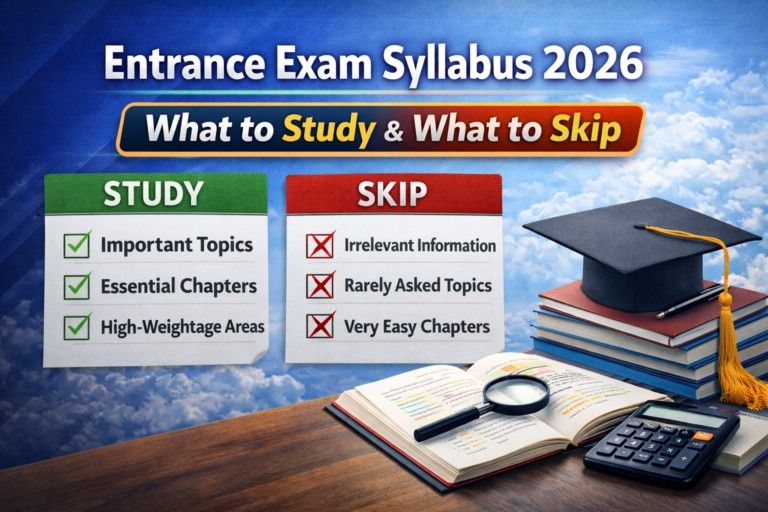
Entrance Exam Syllabus 2026: If you’ve ever opened a fresh entrance exam guidebook only to feel a wave of “how am I supposed to finish all this?” wash over you, you’re in the right place. Whether you are aiming for JEE, NEET, UPSC, or a state-level eligibility test in 2026, the problem is rarely a lack of material—it’s usually an overwhelming surplus of it.
I’ve spent years working with students and analyzing recruitment patterns, and I’ve noticed a recurring pattern: the toppers aren’t necessarily the ones who read every page. They are the ones who mastered the art of the “Selective Syllabus.” By 2026, exam boards are moving further away from rote memorization and toward conceptual application. This means your old strategy of “completing the book” might actually be holding you back.
The 80/20 Rule of Competitive Exams
In almost every competitive exam, 80% of the questions come from 20% of the core topics. Your job is to identify that 20% early.
From my experience, students who try to cover 100% of the syllabus usually end up with 50% retention across the board. However, those who master 80% of the “high-yield” topics with 100% clarity usually end up in the top percentiles.
Step 1: Analyze the “Frequency” (Not the Weightage)
Don’t just look at the marks assigned to a chapter. Look at how often it appears in the last five years of papers.
-
Study: Topics that appear every single year (e.g., Kinematics in Physics or Tenses in English).
-
Skip (or Save for Last): “Outlier” topics that appeared once in five years but take weeks to master.
Read This Also: SSC CHSL Syllabus 2026: Tier 1 & 2 Full Guide + Smart Strategy
A Practical Guide to Sorting Your 2026 Syllabus
Use this table as a template to categorize your subjects. I’ve filled in some general examples based on common 2026 patterns:
| The “Study” List (High ROI) | The “Skip/Delay” List (Low ROI) |
| Foundation Blocks: Topics that are prerequisites for other chapters (e.g., Number Systems, Basic Grammar). | Ultra-Niche Theories: Advanced theories that rarely show up in objective-type exams. |
| High-Frequency Areas: Any topic that has appeared in the last 3 years of mock tests consistently. | Complex Calculative Sinks: Topics that take 10 minutes to solve one question (unless you’ve mastered everything else). |
| Current Context: For 2026, focus on digital literacy, new laws, or recent scientific breakthroughs. | Obsolete Data: Historical stats or outdated tech specifications that have been superseded. |
Real-Life Mistakes: Why “Covering Everything” Fails
I once worked with a student who spent three weeks mastering Fluid Mechanics for an engineering entrance. It was a massive chapter. In the actual exam, there was only one question from it. Meanwhile, he skipped Modern Physics—a much easier section—which had six questions.
The Lesson: Don’t fall in love with a difficult topic just because you want to “conquer” it. The exam doesn’t give you extra points for bravery; it gives you points for correct answers.
Your “Syllabus Filter” Checklist
Before you start a new chapter, put it through this filter. If it fails more than two points, move it to the end of your calendar.
-
Is it a Core Concept? Does this chapter help me understand 3-4 other chapters? (e.g., Percentage in Math).
-
Past Paper Proof: Have there been at least 2 questions from this in recent years?
-
Confidence Level: Do I already have a 40-50% understanding, or am I starting from zero on a very hard topic?
-
Time vs. Marks: Can I finish this in 2 days? If it takes 2 weeks for 1 mark, it’s a “Skip” for now.
How to Build Your 2026 Study Workflow
-
The Diagnostic Phase: Take a full-length mock test now, even if you haven’t studied. See where you naturally score.
-
The “Big Rocks” First: Schedule your High-Yield topics for your peak energy hours (usually mornings).
-
The “Skip” List: Create a physical list of topics you are choosing to ignore for now. This reduces the anxiety of “forgetting” them.
-
The Review Cycle: Every Sunday, look at your “Skip” list. If you are ahead of schedule, pick one small item from it. If not, keep it buried.
Read This Also: Railway RRB Technician Answer Key 2026 Out Check Your Marks
Summary Takeaway
Success in 2026 entrance exams is about strategic abandonment. You have to be brave enough to leave some things behind so you can carry the important stuff more effectively. Master the core, practice the frequent, and don’t let the “filler” content steal your rank.
FAQs: What Students are Worried About in 2026
1. Won’t I lose marks if I skip topics?
Yes, you might lose 2-5 marks. But by focusing that time on core topics, you prevent losing 20-30 marks due to silly mistakes or half-baked knowledge in high-weightage areas.
2. How do I know if a topic is “obsolete” for 2026?
Check the latest official notification from the exam body (like NTA or UPSC). They often remove sub-topics to keep the syllabus relevant. If it’s not in the 2026 brochure, don’t touch it.
3. Is “Study & Skip” risky for highly competitive exams?
It’s actually less risky than trying to learn everything and forgetting it all in the exam hall. Quality always beats quantity in competitive environments.
4. What if a “Skip” topic shows up as a major question?
This is why we use the 5-year frequency check. Patterns rarely shift 100% in a single year. You play the probabilities.
5. Should I skip topics I find difficult even if they are important?
Never skip a “High-Frequency” topic just because it’s hard. Instead, find a “shortcut” version of it—learn the basic formulas and move on, rather than deep-diving into the theory.